Seacom has launched a new high-capacity terrestrial network route linking Nairobi and Kampala, enhancing one of East Africa’s most important digital corridors
The new infrastructure is designed to improve connectivity reliability, increase capacity, and support the region’s growing demand for high-performance internet services.
The route connects major infrastructure hubs in Nairobi, Kisumu and Kampala, creating a more resilient pathway for data traffic moving inland from subsea cable landing stations in Mombasa. It transforms an established connectivity corridor into a modern, high-capacity backbone built to support East Africa’s expanding digital economy.
“We’re strengthening a route that already plays a central role in regional connectivity,” commented David Kariuki, chief technology officer at Seacom.
“We are ensuring that this segment is served by a high-capacity, carrier-grade network that can support the scale and performance today’s digital economy requires.”
Built for a rapidly growing digital economy
The Nairobi–Kampala corridor supports a wide range of sectors, including telecommunications, financial services, cloud platforms and digital commerce. With these industries experiencing continued growth, demand for reliable, low-latency connectivity is increasing across the region.
The upgraded route improves access to international bandwidth while enabling faster and more dependable data exchange between markets.
“The biggest impact will be felt across the broader internet economy,” Kariuki stated. “From service providers and banks to cloud operators and e-commerce platforms, organisations depend on stable connectivity to operate and grow. This investment directly improves their ability to deliver services.”
The infrastructure also strengthens regional connectivity beyond Kenya and Uganda, providing a more efficient route into neighbouring markets including Rwanda, Burundi and South Sudan, supporting cross-border digital services and regional trade.
Greater resilience and service availability
Network reliability was a key consideration in developing the new route, particularly due to historical challenges affecting connectivity along this corridor.
Seacom has deployed Automated Switched Optical Network (ASON) technology, enabling traffic to be automatically rerouted within under 50 milliseconds during network faults. This helps maintain service continuity even during multiple disruptions.
“Service availability has been a major consideration,” Kariuki explained. “By managing and controlling more of the route ourselves, and adding automated switching, we can maintain uptime even when there are breaks along the network.”
The route provides latency of approximately 7 milliseconds to Nairobi and 13 milliseconds to Mombasa, supporting real-time applications such as financial transactions, cloud workloads and enterprise services.
Alongside the traditional A104 corridor, Seacom will utilise an alternative route through Narok, Kericho and Kisumu. This dual-path strategy reduces reliance on a single connection and improves overall network resilience.
The use of two border crossings, Malaba and Busia, further enhances reliability by reducing single points of failure and improving stability for customers operating across borders.
Scalable infrastructure for long-term growth
The Nairobi–Kampala route has been designed to accommodate future digital demand. At launch, the network provides 1Tbps of capacity, with scalability up to 30Tbps as requirements increase. This enables Seacom to expand capacity without significant infrastructure redesigns.
“Demand for data in East Africa is accelerating,” commented Kariuki. “We’ve designed this network to scale alongside that growth, so clients can increase capacity as their needs evolve.”
Based on DWDM technology, the route supports multiple high-capacity interfaces, including 1GE, 10GE, 100GE and 400GE, providing flexible connectivity options for enterprises, service providers and hyperscale customers.
Strengthening Seacom’s regional network strategy
The new route forms part of Seacom’s wider investment in East Africa’s digital infrastructure.
“This is a continuation of the work we’ve been doing to strengthen our network across the region,” Kariuki said. “We upgraded our IP network in Uganda last year, and this route builds on that foundation by improving both capacity and quality across a key corridor.”
As digital services continue expanding across East Africa, the Nairobi–Kampala route provides a stronger foundation for connectivity, supporting economic development and enabling the region’s next phase of digital growth.
Seacom builds East Africa’s next digital highway
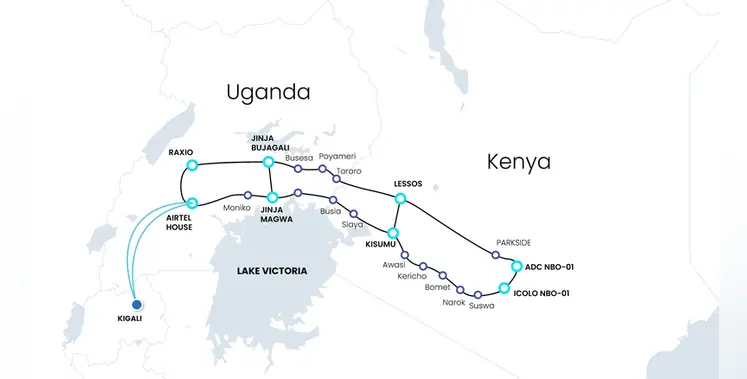
Seacom’s new Nairobi-Kampala route strengthens regional connectivity with higher capacity, resilience and scalable digital infrastructure. (Image source: Seacom)