MTN Group’s digital infrastructure arm, Bayobab, was among the consortium members honoured at a ceremony in Cape Town, celebrating the completion of the world’s longest subsea cable infrastructure project.
This achievement marks a major step forward in global connectivity and reinforces MTN’s position, through Bayobab, as a key digital ecosystem driver committed to providing Africans with hope, dignity, and opportunity.
2Africa, a digital infrastructure initiative spearheaded by META, is the first subsea system to offer a continuous connection between East and West Africa, with further extensions to the Middle East, South Asia, and Europe. The project, nearly six years in the making, traverses 50 jurisdictions and required ongoing adaptability to evolving regulatory and technical landscapes.
Its successful completion represents years of cooperation, engineering progress, and a unified commitment from 2Africa consortium members to connect people, stimulate economic advancement, and support transformative digital services across Africa and beyond.
“For MTN, 2Africa isn’t just a cable but rather a statement of intent of what can be achieved when the world’s technology leaders and Africa’s own champions come together with purpose,” said Mazen Mroué CEO, MTN Group Digital Infrastructure, receiving the award on behalf of MTN and Bayobab.
“This project stands as proof that global scale and African leadership can combine to build the infrastructure that will define the next chapter of Africa’s growth story. Yes, together we’re connecting Africa to the world, but above all, we’re connecting Africa to its potential.”
2Africa brings a major upgrade to Africa’s international bandwidth. On the West route between England and South Africa, the system provides 21 Tbps per fibre pair across eight fibre pairs, reaching a total of 168 Tbps. In the Mediterranean, shorter routes allow more than 30 Tbps per fibre pair, and with 16 fibre pairs the system exceeds 180 Tbps in those sections.
This substantial increase in capacity is projected to contribute up to US$36.9 billion to Africa’s GDP within its first two to three years of operation, supporting employment, entrepreneurship, and the growth of innovation ecosystems across the region.
With more than 33 landing points and additional sites forthcoming, 2Africa is expected to support connectivity for around 3 billion people — representing over 30% of the global population. This unparalleled scale has only been possible through wide-ranging cooperation across the digital ecosystem.
Mroué said, “At MTN, we view connectivity as the foundation of Africa’s digital future. Through Bayobab, we bring world-class infrastructure capability and the reach of a network serving over 300 million subscribers across 16 African markets. Of course, the Bayobab footprint, which embeds just under 135 thousand kilometres of cable extends beyond these markets to accelerates Africa’s Digital Transformation and AI adoption.”
Constructing 2Africa demanded significant innovation in subsea engineering. The system delivers double the capacity of older networks and integrates undersea optical wavelength switching, enabling adaptable bandwidth management to meet growing needs for AI-enabled data centre solutions, cloud services, and high-capacity applications.
The project deployed advanced Spatial Division Multiplexing (SDM) technology and incorporated optical wavelength switching beneath the sea for dynamic bandwidth allocation. Cable burial depth was increased by 50%, and routing was carefully planned to avoid risks such as hot brine pools and the Congo Canyon’s turbidity currents, ensuring both performance and durability.
More than 35 offshore vessels and extensive local teams were engaged, supported by specialised equipment to ensure safe and resilient installation across 50 jurisdictions.
2Africa’s achievement is rooted in collaboration. The consortium, led by Meta, included Bayobab, center3, CMI, Orange, Telecom Egypt, Vodafone Group, and WIOCC.
The celebratory event took place at the Zeitz Museum of Contemporary Art Africa in Cape Town.
2Africa cable project successfully completed
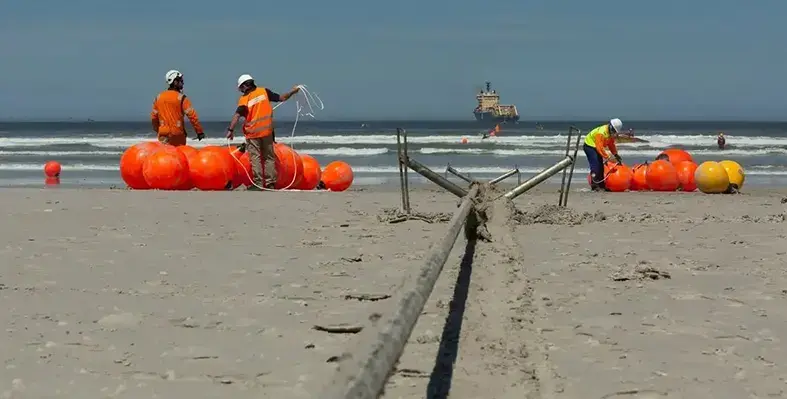
2Africa subsea cable Africa connectivity project. (Image source: Bayobab)